
Rensselaer County Deed Records and What They Show
Rensselaer County public-record detail
| Deed Type | What It Does | Common Use |
|---|---|---|
| Warranty deed | Rensselaer County public-record detail | Rensselaer County public-record detail |
| Quitclaim deed | Rensselaer County public-record detail | Rensselaer County public-record detail |
| Grant / special warranty | Rensselaer County public-record detail | Rensselaer County public-record detail |
| Trustee / executor deed | Rensselaer County public-record detail | Rensselaer County public-record detail |
| Tax deed | Rensselaer County public-record detail | Rensselaer County public-record detail |
Rensselaer County public-record detail
The Rensselaer County Grantor-Grantee Index
Rensselaer County public-record detail
- Rensselaer County public-record detail
- Rensselaer County public-record detail
- Rensselaer County public-record detail
- Rensselaer County public-record detail
- Grantor
- Rensselaer County public-record detail
- Grantee
- Rensselaer County public-record detail
- Chain of title
- Rensselaer County public-record detail
- Book/Page vs Instrument #
- Rensselaer County public-record detail
Getting a Copy of a Rensselaer County Deed
Rensselaer County public-record detail
Recorded, not guaranteed. Rensselaer County public-record detail
The 1980 Image Boundary in Rensselaer County Deed Records
Rensselaer County deed records on SearchIQS start at different points depending on the instrument. Deed images reach back to May 30, 1980. Mortgage coverage begins in 1989. Grantee books from 1973 through 1989 can still yield index data. That applies when no image exists online. When a backward chain hits that boundary, the County Clerk's older deed books and records-room staff take over. Stop cycling through spelling variants. Change venues instead. Some transfers never appear as an ordinary sale at all. Manor leases, historic maps, Hart Cluett title-search files, and Surrogate records often explain those gaps. Those gaps occur in Rensselaer County property records. The official SearchIQS landing screen is the County Clerk's route into the online index.
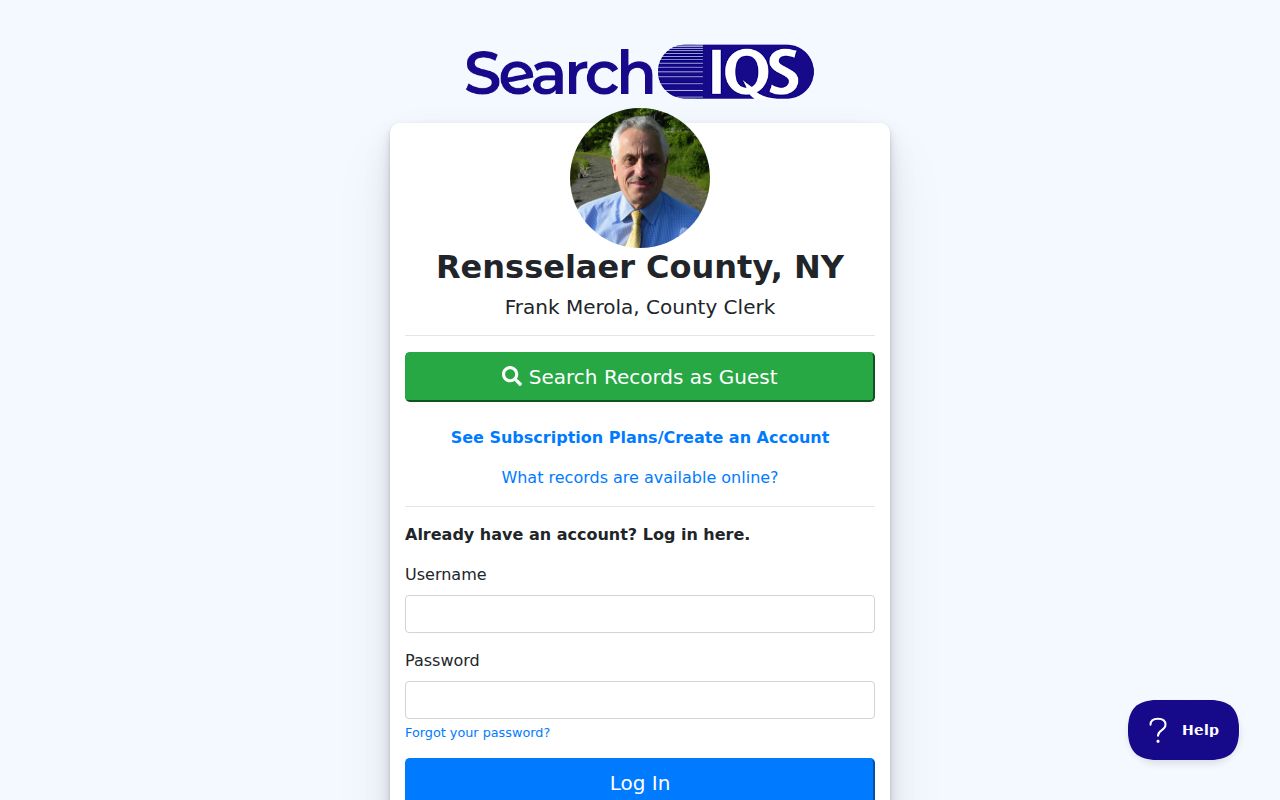
Use the index result to identify the instrument. Then obtain the recorded image or a certified copy suited to the purpose at hand.
Read the SearchIQS Coverage before Searching
Coverage inside SearchIQS varies by instrument, so read it first. Deed images in Rensselaer County run from May 30, 1980 forward. Mortgages start in 1989. Grantee index books from 1973 through 1989 may return index entries without an online image. Those dates mark search boundaries, not the start of land ownership, and anything older stays a County Clerk records-room task.
Search both sides of every transfer. The grantor conveys the interest. The grantee receives it. Begin with the current grantee, find that party's acquiring deed, then search the named grantor as grantee in an earlier period, recording instrument type, date, book and page or instrument number, and the parcel description as you go. This backward method beats hunting one surname across every year of Rensselaer County deed records.
Deed vocabulary. Chain of title means the linked sequence of transfers. Book/page and instrument number are recording references, while an SBL is an assessment identifier.
Distinguish Deeds from Mortgages, Liens and Maps
A deed can convey title. The County Clerk indexes far more: mortgages, satisfactions, assignments, judgments, mechanics liens, lis pendens, easements, and maps. Each answers a different question. A mortgage documents a security interest, not a new owner. A satisfaction shows a recorded mortgage was discharged. A lis pendens flags litigation affecting real property. A judgment points to a claim that needs review before you read it into Rensselaer County property records.
| Instrument | What to Extract | Why It Matters |
|---|---|---|
| Deed | Grantor, grantee, date, description | Documents a transfer |
| Mortgage | Borrower, lender, amount, parcel | Shows recorded security |
| Satisfaction | Original mortgage reference | May document discharge |
| Lis pendens | Court and index reference | Points to litigation |
| Map or easement | Map number, land, rights | Explains layout or use |
Do not mistake a tax map for the recorded plat. Municipal PDF tax maps serve assessment administration. The recorded document comes from a filed map, deed description, or easement in the Clerk's records, and a boundary conclusion may still need a surveyor.
Trace a Rensselaer County Chain of Title
Build a transfer table as the search moves. For each deed, log execution and recording dates, grantor, grantee, deed type, consideration language, the recording reference, and the prior deed cited in the description. Compare municipality and SBL across entries. Older deeds may instead rely on metes and bounds, lot and block, a filed-map reference, or a manor lease description rather than the modern assessment number, so let the era shape how you read each Rensselaer County parcel.
- Identify the present parcel in PROS and copy its SBL.
- Locate the newest deed in SearchIQS and verify the land description.
- Use its grantor and prior-instrument reference to find the preceding deed.
- Continue backward until the online image range ends or the description changes.
- Carry the last reliable reference to the records room or an archive.
A quitclaim, executor, or life-estate deed does not automatically signal a defect. It simply describes a transfer. That transfer must be read in context. Sale consideration and the price reported through RP-5217 or SalesWeb are related but not interchangeable. Preserve the source and date for each figure.
When the Deed Chain Moves into Local History
Older land history sometimes requires names that no longer identify the municipality. Lansingburgh was annexed to Troy in 1900. Greenbush became the City of Rensselaer in 1897. Bath, with part of western East Greenbush, was annexed in 1902. Keep those names in mind. An older deed, directory, map, or tax record may use the historical jurisdiction when describing the same Rensselaer County land.
Van Rensselaer Manor leases can explain an early chain's odd start. An early chain may never begin with a conventional sale deed. The New York State Library maintains a finding aid for early lease and manor material. Hart Cluett's Charles Cohen Collection holds later title-search files. The collection also holds county Surrogate records from 1791 through 1915. These are leads for extending a documented chain. They are not substitutes for matching the item to the parcel.
Copies and the County Clerk Records Room
The Rensselaer County Clerk Records Room sits at 105 Third Street in Troy. The county documents in-person, mail, and online access. It also publishes a fee schedule for recording, copies, and certification. Check the current schedule before requesting a copy. A screen image, a plain copy, and a certified copy serve different purposes. Supply party names, instrument type, recording reference, and an approximate date to cut down ambiguity.
Recording proves an instrument entered the public record. It does not guarantee the signer held good title or that every interest is shown. A full title examination can draw on deeds, probate, judgments, tax matters, maps, and off-record issues. These are evaluated by a qualified professional. Rensselaer County deed records are the evidence base, not a legal conclusion.
Property Fraud Alerts Do Not Replace Deed Review
Rensselaer County runs a Property Fraud Alert service through the County Clerk system. A subscriber picks a name. When a document gets indexed under that name, the service sends a notice. The county itself cautions that same-name alerts happen. So treat any alert as a prompt to pull the indexed document, not as proof that the parcel was transferred.
That means comparing details. Check the alerted party, the instrument type, the recording date, and the property description against the owner's deed chain. A notification cannot stop a recording, verify identity, or remove an instrument from the property records. It also cannot judge validity. A suspicious recording belongs with the County Clerk. Legal rights call for a qualified New York attorney. Keep alert confirmations filed apart from the deed evidence itself.
Research note: Preserve spelling variants, middle initials, and recording references exactly as indexed, since small transcription differences can separate two valid results in the deed records. This matters most when a family reused names across several Rensselaer County parcels.